

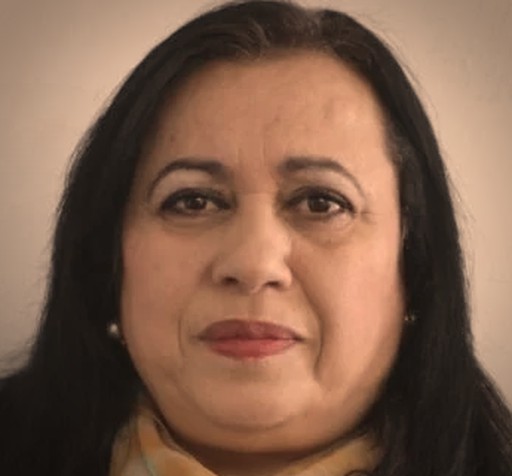
When Amal Hadweh met Marshall Rosenberg in 1994, sparks flew — in a manner of speaking. “The first thing he said,” Amal recalls, “was that ‘Man is good in nature.’ And then I said, ‘No, I don’t believe that. I think man is bad in nature until he proves the opposite.’” Amal pauses, her eyes in a distant place. An affectionate smile crosses her face. “And then he looked at me with his sneaky eyes and his glasses, the way he used to look, and he said, ‘You, I think you will be a very successful NVC trainer.’”
With this surprising turn, the NVC founder disarmed the friction that can so often arise from opposing views, and introduced an opportunity. Yes, sparks flew, but not the sparks of discord. Ignited within Amal was a spark that would change the trajectory of her life.
One look into Amal’s eyes calls forth the proverb, still waters run deep. Within her intense, serious expression undulates a profound kindness, a radiant empathy, and a deep concern for the well being of all people. She was born to lead. Indeed it was a leadership role that positioned her to intersect with Marshall Rosenberg in one of the most conflict-riddled regions of the world, her homeland, the Palestinian Territory.
At the time just 26 years old, Amal was a high school principal in the Deheisheh refugee camp. A lifelong citizen of Beit Jala, a Christian suburb of the Bethlehem Governorate on the West Bank, she held a bachelor’s degree from Bethlehem University, and by 1994 had worked for the United Nations (U.N.) for a decade. Amal points out that her first meeting with Marshall Rosenberg occurred in the wake of the “first Intifada of the Palestinian people,” a rebellion against the Israeli occupation with peak escalation from 1987 to 1993.
But in the eyes of one who has lived a history that much of the world has watched from afar, the notion of a date range seems an academic luxury amid the oppressive violence of life in a conflict zone. There was, Amal reflects almost too simply, “a lot of violence at that time.”
Marshall had come to the epicenter of the Palestinian-Israeli conflict to present his NVC model to the U.N., which “decided that this is better given to the Education Department, to the schools,” Amal reflects. She became one of nine Palestinian school principals chosen to take Marshall’s one-week NVC workshop. “Luckily,” she says, “the course was offered at my school.”
As the host principal, Amal quickly found herself in close quarters with the NVC visionary. “He came with me home,” she recalls, fondly. “We had lunch together, and he slept in our house with my husband and with my children. So all the family knew Marshall Rosenberg.”
During that week, as she worked with Marshall and her workshop peers, a profound change began to settle over Amal. “I felt that something had been broken inside myself,” she reflects, “that a light has been coming out, from inside all these rocks and all these cracks that were built inside me.” She began seeing others not as enemies, but as friends with needs different from her own, or with the same needs, but with different strategies for how to meet those needs.
“I had this concept in my soul, and that was the moment, or the key shift that happened to me, and it has remained with me all my life.”
She began collaborating with Marshall. Through the year 2000, he returned each year to help Amal lead NVC workshops at schools in Palestine, Israel, and Serbia. Through all this time, Amal considered herself ever “one of his students.” Then at a retreat in England, he said to her surprise, “Amal, now I am certifying you. You can go and do NVC trainings,” she recalls, with emotion. She continued working with Marshall Rosenberg until his death in 2015.
Today, Amal Hadweh serves as the lead Palestinian trainer for NVC-Mideast. A member of the advisory board at محافظة بيت لحم Bethlehem Governorate and a trustee for Bethlehem University, she went on from her early NVC days to complete a Ph.D. from the American World University. She sits on the Beit Jala municipal council, and continues to lead workshops to help transform the culture of violence in this region she so loves. In 2018, she led the first Empowering Palestinian Women Leaders project, a program that continues to thrive and create space for women to discover and cultivate their leadership talents in a traditionally patriarchal system.
Amid the violence that persists to this day, Amal–who lives very near the border between the Palestinian Territory and Israel–testifies to the love and mutual respect that she experiences, person to person, neighbor to neighbor, saying, “we have many Israeli friends, and they have many Palestinian friends.” She believes the problem lies with the power structures, not the people, and that great strides toward peace are possible if leadership embraced Nonviolent Communication. “Not only here in Palestine, and not just in Israel,” she emphasizes, but across the entire world.
“What is important for me is to continue being determined to go on with this,” Amal says, radiating determination. “I promised Marshall that one day, we will have NVC in Palestine. That has been a dream for me for the last twenty years, and I’m thinking my dream is coming true slowly, slowly, slowly.” With each repetition, Amal’s expression becomes more and more resolute. “Yes, we have violence. But we still have peace, and we still believe in nonviolent education and nonviolent action.” She says, punctuating the thought, “The circle of NVC.”